



.png)

Eton
Windsor and Maidenhead

Windsor and Maidenhead
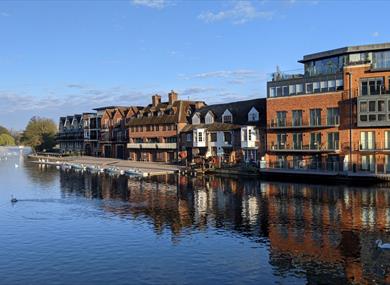
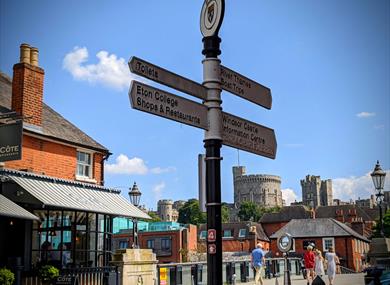
On the opposite bank of the River Thames from Windsor lies the town of Eton. Connected by a footbridge, Eton has an importance of its own both historically and commercially.
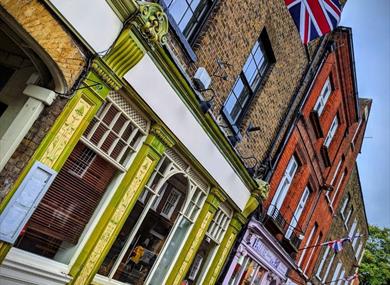
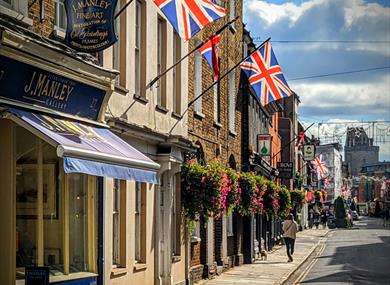
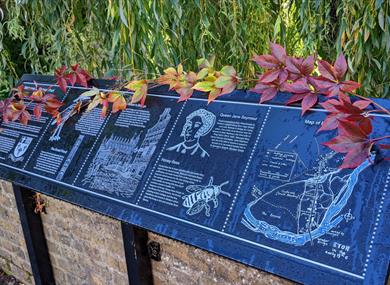
Eton High Street is the main street of the separate community of Eton and has remained unchanged for many years. Royal processions from Westminster to Windsor passed along this road, one of the most famous being the funeral in 1537 of Jane Seymour, the third wife of Henry VIII.
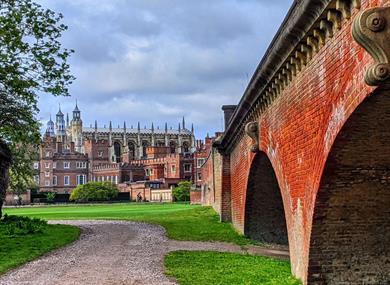
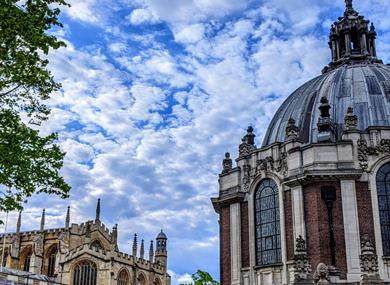
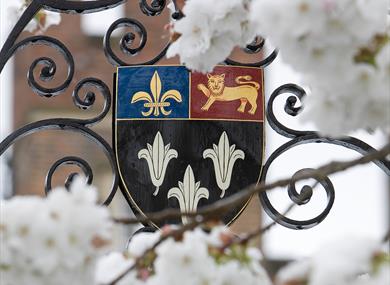
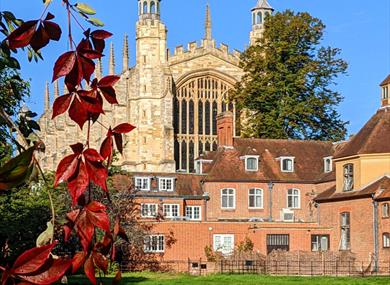
It is impossible to think of Eton without reference to its famous public school, Eton College, and indeed the later history of the town is inseparably entwined with that of the college.
Although the vehicular access from Windsor across the river bridge (built in 1822) has now been closed, many people cross each year to admire the architectural delights of Eton and its college and to walk down the high street containing some finely preserved shop fronts.
These include the Tiger Garden restaurant, a typical example of 15th-century timber framed architecture. Part of this building was used as an inn in the 16th century, called The Adam and Eve. Its local name The Cockpit dates from 1936, making reference to a rear slaughterhouse, incorrectly thought to be a cockpit. The post-box next to the restaurant is an early example of its type, dating from 1854.
At the time of the Domesday survey Eton was noted as being thickly wooded and its name is derived from Eyot-tun which means 'the settlement on the island', a probable reference to the way the Thames divided in earlier times.
The bridge over the stream known as Barnes Pool has been subject to a trust since at 1592 and probably earlier. The trustees were empowered to purchase property in Eton High Street and rents were used for various local needs.
Eton College occupies the whole of Eton north of Barnes Pool bridge and was founded by King Henry VI in 1440 and is second only to Winchester as the oldest public school in England. Unfortunately Eton College is not open to the public but you may be able to catch a glance through the entrance way of a statue of the founder by Francis Bird (1719) in the cobbled court of School Yard.
The parish church, which is dedicated to St John the Evangelist, was consecrated in 1854 and stands near the site of the original church which was pulled down when the College Chapel was completed at the end of the 15th century and which for more than 250 years performed the function of the parish church.
The modern residential area of Eton Wick is a mile west of the town and is separated from it by South Field which, as with most open land in the area, is subject to Lammas (or Loaf Mass) and Common rights handed down since the 7th century. The red-brick church of St John the Baptist was consecrated in 1867 by Samuel Wilberforce, then Bishop of Oxford.
Alexandra Gardens is a pretty public garden near the River Thames in Windsor with…
Fancy sampling locally brewed beer? Then look no further than Windsor and Eton Brewery.
On the banks of the River Thames, under the shadow of Windsor Castle, this prestigious…
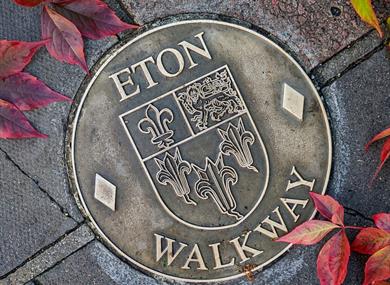
The Eton Walkway, a 2-mile/one-hour circular walk, connects 18 points of interest in the…
Eton’s hidden gem, this family friendly museum is Berkshire’s only dedicated natural…
The Theatre Royal Windsor is a beautiful Edwardian theatre nestling between Windsor…
You haven’t seen Windsor until you’ve seen it by Duck! Laugh, learn and enjoy our 1 hour…
The historic buildings are an integral part of the heritage of the British Isles.…
The best way to experience the sights of this ancient royal town is with one of our…
Spirit of England Tours offer you and your group professional blue badge guided tours of…
** Windsor & Royal Borough Museum is temporarily closed to improve the visitor experience…
The Changing of the Guard is one of the highlights of a visit to Windsor. A band usually…
Windsor Castle is the oldest and largest occupied castle in the world and the Official…
The Old Court is a vibrant arts centre with an event programme that features an eclectic…
Racecourse Marina is one of the premier marines in the Thames Valley. We aim to provide…
Late 17th-century royal residence, particularly associated with Queen Charlotte and Queen…

© Visit South East England 2026. All Rights Reserved