




.png)

Ascot
Windsor and Maidenhead

Windsor and Maidenhead
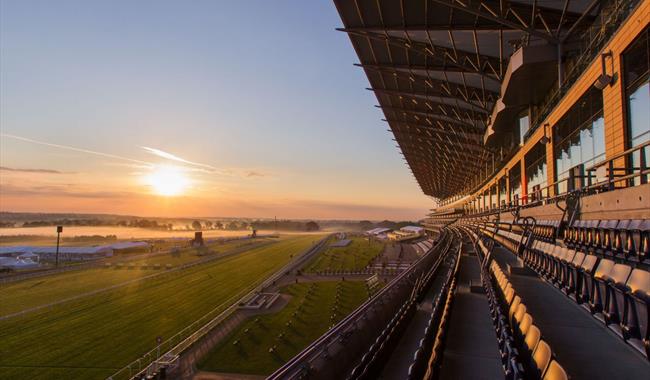
Though a pretty Berkshire town in its own right, it's fair to say that Ascot is dominated by its spectacular racecourse. Certainly one of the world's finest and most famous courses, Ascot attracts over half a million visitors each year.
Ascot Racecourse can trace its history back to 1711 when Queen Anne arranged the first meeting. Today's racecourse, redeveloped in 2006, is a sight to behold, with enormous, terraced stands and immaculate grounds.
Mid June is prime racing time. While there are meets throughout the year at Ascot, nothing compares to Royal Ascot – an incredible display of world class horse racing, extravagant hats, and socialising on an epic scale. You'll also see members of the Royal Family process each day at 2pm during Royal Ascot – a tradition that dates back to 1825.
Away from the races you'll find an attractive town with plenty of shops and restaurants, as well as lively bars and music venues. Fitting perhaps, as Ascot is where Girls Aloud singer Sarah Harding was born.
Things to do in the Ascot area
For more inspiration of what to do in Ascot, check out our Berkshire events guide. A selection of towns near Ascot can be viewed on our map of Berkshire.
The railway was brought to Ascot in 1845 for the purposes of the races and is a short walk from the High Street. Regular services run from Reading and Waterloo. Ascot is approximately 45 minutes drive from London and is located very close to M3, M4 and M25 motorways and to Heathrow Airport.
Ascot Racecourse is synonymous with quality, excellence and a truly memorable day out.…
Founded in 1928, The Berkshire Golf Club is home to two Herbert Fowler designed courses,…
Windsor Great Park covers 4,800 acres, huge parts of which are open to the public.…
Find out why this has become one of Berkshire's most popular attractions with with 3…
Axe Throwing
Every tried slinging an axe? Not only is it the perfect stress-reliever but…
If you are looking for a fun day out, then The Look Out Discovery Centre is worth a visit…
Adventure Play is a unique, hand-crafted adventure playground at Windsor Great Park.…
Chobham Common is the largest National Nature Reserve in the southeast of England and one…
The Savill Garden is a garden of beauty and colour where visitors journey through 35…
The LEGOLAND® Windsor Resort is a unique family theme park where children aged 2 -12 can…
The Country Park is predominately heathland habitat, but there are also ponds, woodland,…
This memorial overlooks the River Thames and commemorates by name over 20,000 airmen who…
Large range of public trips on weather-proof vessels from Windsor, Runnymede and…
Set in a symbolic acre of land donated to the United States of America by Queen Elizabeth…
The Old Court is a vibrant arts centre with an event programme that features an eclectic…
Late 17th-century royal residence, particularly associated with Queen Charlotte and Queen…

© Visit South East England 2026. All Rights Reserved